
Brand Positioning vs Brand Identity: What's the Difference?
Brand positioning is the strategy. Brand identity is the execution. Here’s how the two work together, and why confusing them costs brands money.

Brand positioning is the strategic decision about where your brand sits in a customer's mind relative to competitors. Brand identity is the visual and verbal system, your logo, colors, typography, voice, that makes that position visible and memorable. Positioning answers “why choose us.” Identity answers “how do people recognize us.” One is the argument. The other is the evidence.
Founders confuse the two constantly, usually because agencies sell them as one bundled product. A new logo gets called “rebranding.” A tagline gets called “positioning.” Neither is wrong exactly, but neither is complete on its own. A brand with a striking identity and no positioning is a beautiful mark with nothing to say. A brand with sharp positioning and no identity is a good idea nobody can picture.
What Brand Positioning Actually Is
Positioning is a strategic claim: this is who we’re for, this is what we deliver that alternatives don’t, and this is why that matters right now. It lives in a positioning statement, in messaging hierarchy, in the language your sales team uses on a call. It’s decided before a single visual is designed.
Positioning answers three questions:
- Who is this for, specifically? Not “everyone who needs X” but a defined audience with a defined problem.
- What do we do differently, better, or with more conviction than the alternative? This is the competitive wedge.
- Why should that difference matter to the buyer right now? Relevance beats cleverness.
A positioning statement is internal-facing first. It shapes how you write a homepage headline, how a sales team opens a pitch, and what a designer is briefed to visualize. Skip this step and every downstream decision, from color to copy, gets made on instinct instead of strategy.
What Brand Identity Actually Is
Identity is the system that expresses positioning in the world: logo, color palette, typography, imagery style, tone of voice, and the guidelines that keep all of it consistent across a website, a pitch deck, a product label, and a social feed. Identity is what a customer actually sees, hears, and remembers.
Good identity work translates a strategic decision into sensory language. If your positioning is “the confident, no-nonsense alternative to bloated enterprise software,” your identity should look and sound confident and no-nonsense, not soft and apologetic. When identity and positioning align, every touchpoint reinforces the same claim. When they don’t, the brand feels inconsistent even if every individual asset is well designed.
How They Work Together
Positioning sets the direction. Identity gives it a face. Neither functions well without the other, and treating them as sequential rather than separate is the difference between a brand that compounds and one that has to be re-explained constantly.
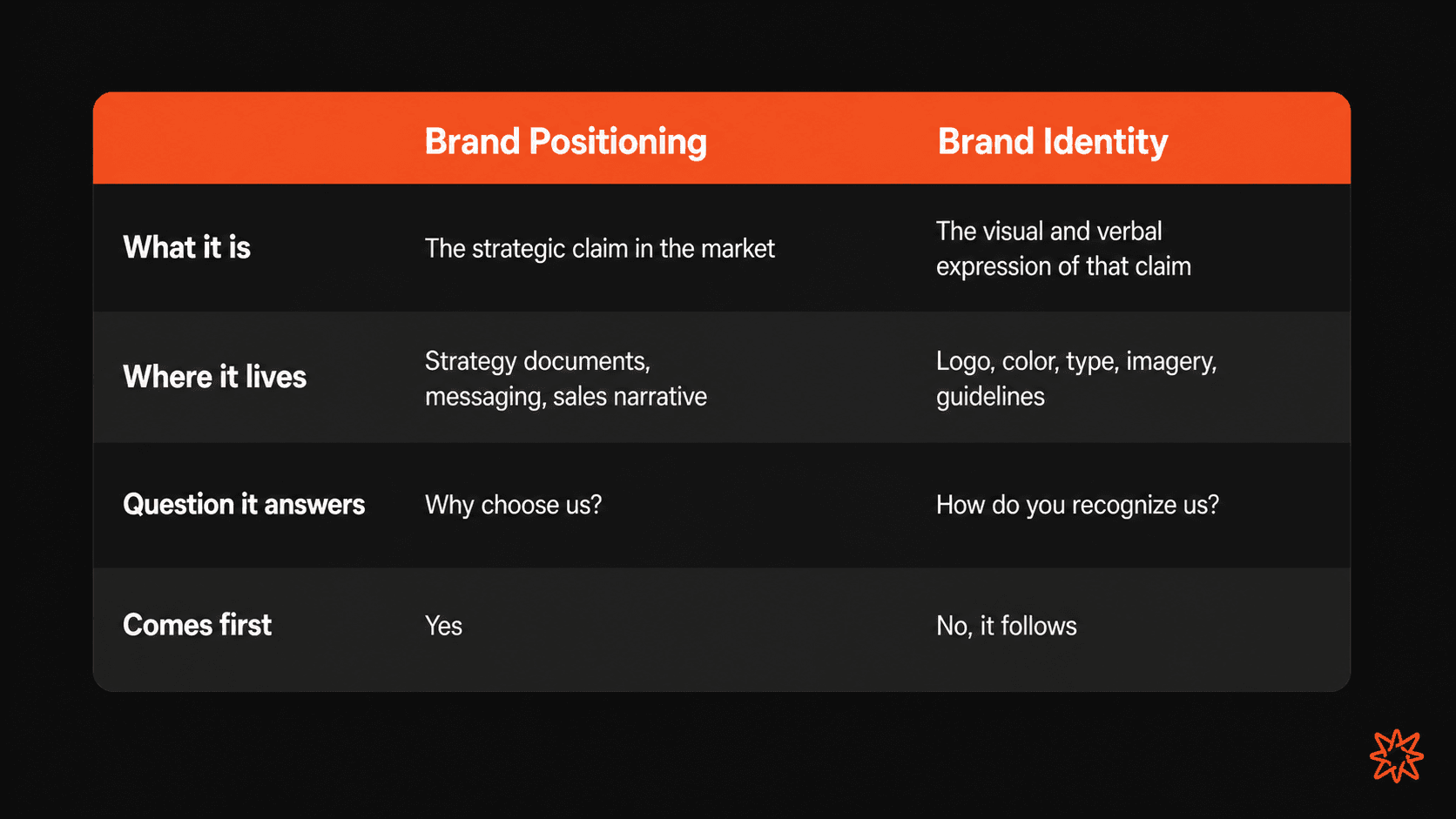
Brand positioning: the strategic claim in the market; it lives in strategy documents, messaging, and sales narrative; it answers “Why choose us?” and it comes first.
Brand identity: the visual and verbal expression of that claim; it lives in logo, color, type, imagery, and guidelines; it answers “How do you recognize us?” and follows positioning.
This sequencing is not a formality. Design decisions made without a positioning brief tend to default to whatever looks good in the moment, not what serves the strategy. That’s how brands end up with identities that are polished but interchangeable with a competitor’s.
What Happens When Identity Moves Without Positioning
Tropicana’s 2009 packaging redesign is the textbook case. PepsiCo replaced the brand’s recognizable orange-and-straw imagery with a minimalist glass-of-juice graphic. The visual system changed, but the positioning, the emotional shorthand customers relied on to find the product on a shelf, was never re-communicated. Sales dropped 20% within two months, a loss of roughly $30 million, and the company reverted to the original packaging within weeks (Packaging Digest).
The redesign wasn’t badly designed. It was disconnected from the strategic reason customers chose the brand in the first place. That’s the risk of treating identity as a cosmetic refresh instead of an expression of positioning: you can lose the very recognition you’re trying to strengthen.
Which Comes First?
Positioning, always. Identity follows positioning, never the other way around. Skipping straight to a new logo because the current one “feels dated” treats a strategic problem as a visual one. If customers are confused about what you do, if you’re competing on price because nothing else differentiates you, if your team can’t agree on your story in one sentence, that’s a positioning problem. No amount of typography will fix it.
This is why a proper brand engagement starts with strategy: defining the audience, the differentiation, and the narrative, before a single visual direction is explored. Identity work done after that foundation moves faster and lands harder, because every design decision has a strategic reason behind it rather than a stylistic one.
How to Know Which One You Need
Ask which of these sounds like your situation:
You need positioning work if: your team describes the business differently depending on who’s asking, you’re winning deals on price rather than value, or a rebrand hasn’t changed how customers perceive you despite a new look.
You need identity work if: your positioning is clear and validated, but your visual and verbal presentation doesn’t reflect it, looks generic against competitors, or has become inconsistent across channels as the business has grown.
You need both if: you’re launching new, entering a new market, or your last rebrand was a surface change that didn’t touch the underlying strategy. This is the most common starting point for founders who’ve outgrown a DIY brand.
Consistency between the two compounds. Brands presented consistently across every channel see revenue gains as high as 33%, according to Lucidpress and Marq’s brand consistency research, precisely because customers aren’t relearning who you are at every touchpoint. That consistency is only possible when identity is built to express a clearly defined position, not guessed at independently.
FAQ
Is brand positioning part of brand identity, or separate?
Separate, but sequential. Positioning is the strategic decision; identity is one of the ways that decision gets expressed. Messaging, pricing strategy, and product experience are also expressions of positioning, alongside identity.
Can you have strong brand identity without clear positioning?
Yes, and it’s a common failure mode. The identity looks professional but doesn’t differentiate the business from competitors, because there was no strategic claim guiding the design decisions.
Do I need to redo my identity every time I refine positioning?
Not necessarily. Minor positioning refinements can often be absorbed by existing identity through updated messaging. A fundamental repositioning, a new audience or a new category claim, usually does require identity work to stay aligned.
Which should a startup define first?
Positioning, before any visual work begins. Defining who you’re for and why you’re different costs nothing but time and prevents expensive identity rework later.
How do I know if my current identity still matches my positioning?
Run a brand audit: compare what your visuals and messaging communicate against what your actual differentiation and audience are today. Misalignment usually shows up as generic visuals, inconsistent tone, or a brand that “doesn’t feel like us anymore.”
If your brand’s look and your brand’s story have drifted apart, that gap is worth closing before it costs you recognition. Explore our Brand Strategy and Visual Identity services, see brands we’ve built from strategy up, or talk to us about your brand.